Why PeerPost stays quiet when you have not shipped
PeerPost6 min read

Every tool in this category is sold on volume. Thirty posts a month. Never run out of content. Fill your calendar. The pitch is always the same, and it is always some version of more.
PeerPost will sometimes produce nothing at all. Not as a failure state. As the correct answer.
This is the most important decision in the product, and it is worth explaining properly, because on the surface it sounds like we are advertising a limitation.
The problem with a schedule
Here is the mechanism, and once you see it you cannot unsee it.
A content tool that guarantees output on a schedule has made a promise it cannot keep honestly, because it does not control the input. It promises you a post on Tuesday. It does not, and cannot, promise that you shipped something by Tuesday.
So what happens on the Tuesday after a week where you refactored the billing client, bumped some dependencies, and fixed a flaky test?
The tool still owes you a post. The schedule is the contract. And so it does the only thing it can do: it makes something up. Not maliciously. It stretches. A dependency bump becomes "investing in platform stability". A refactor becomes "rearchitecting for scale". A flaky test becomes "hardening our infrastructure". None of it is quite a lie, and all of it is filler, and your reader can smell it from two lines in.
That is the good case. The bad case is an LLM with a mandate to produce a post and nothing real to write about, which is a machine perfectly designed to hallucinate a product milestone you never shipped.
One invented claim is not a small cost
The reason this matters more than it looks is that trust is not additive. It is multiplicative, and it has a zero in it.
Suppose you post forty times. Thirty-nine are true, specific, verifiable things you actually shipped. One is a feature you never built, invented by a tool that needed something to say on a slow week.
You have not lost 1/40th of your credibility. You have lost the ability to be believed, because the reader who catches the invented one now has to wonder about the other thirty-nine. Every prior true statement is retroactively downgraded from "fact" to "claim". The whole archive gets repriced.
And you would not even know which post did it. You did not write it. You approved it in six seconds on a Tuesday while thinking about something else.
This is the trade every "AI content" tool is silently asking you to make: it will give you volume, and in exchange it will occasionally speak for you, in your voice, about things you did not do. For most product categories that trade is survivable. For a founder building credibility with other technical people, it is fatal, because technical people check.
Abstention is a feature, and it is a hard one
The engineering decision that follows is simple to state and unusual to build: when there is nothing to ground a post on, produce nothing.
PeerPost's posts are built from your commits. Every sentence has to trace back to a specific one. If a week of commits contains nothing that changed what a user can do, then there is no sentence that can be written that traces to anything, and so no post gets written.
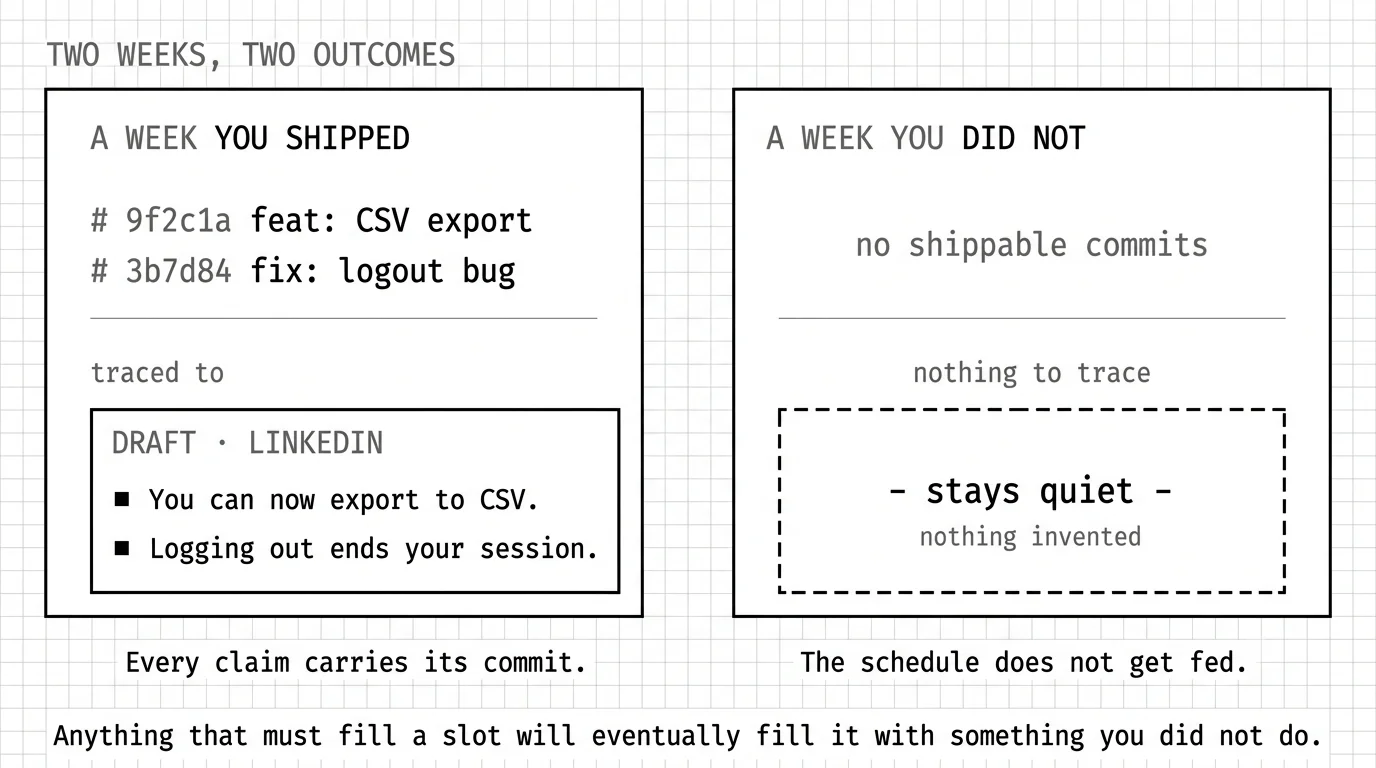
Not a shorter post. Not a "here is what we are working on" post. Not a thought-leadership post to keep the streak alive. Nothing.
This is harder to build than it sounds, because the easy path is always available. The model can always write something. Ask any LLM to produce a LinkedIn post about a week of dependency bumps and it will happily oblige, at length, with enthusiasm. Refusing is a decision that has to be made deliberately and defended in the product, over and over, against the constant pull of "but we could just...".
The rule that makes it tractable is the grounding rule. We do not ask the model "is this week interesting?", which is a judgement call it will always answer yes to. We ask "does any commit here change what a user can do?", which is closer to a fact. No such commit, no post.
What you get for the silence
You get a feed that means something.
If PeerPost only posts when you shipped, then a post from you is evidence that you shipped. Your feed stops being a stream of content and becomes an instrument that people can actually read. Followers learn, without being told, that you do not waste their attention. That is a rare and durable thing, and it is unbuyable at any volume.
And the quiet weeks stop costing you anything. A month of silence from an account that has never once posted filler reads as "heads-down", because that is what it has always meant. The account has no history of crying wolf, so nobody reads the silence as abandonment.
Compare that to what a schedule buys you: a reader who knows a post from you means it is Tuesday.
The honest version of the pitch
So here is the pitch, stated the way we actually believe it rather than the way it would convert best:
PeerPost will probably post less than whatever else you were considering. On a slow month it might post twice. If you shipped nothing at all, it will post nothing at all, and it will not apologize for that or offer you a "content idea" to fill the gap.
What it will never do is tell people you built something you did not build.
That is the whole trade, stated plainly. If what you want is volume, there are a dozen tools that will give it to you, and they are not lying about what they do. If what you want is for the thing under your name to be true, request an invite.
We wrote more about the reasoning behind this in build in public without becoming a marketer, which is the same argument from the other end.
Questions.
Why would a content tool ever refuse to write?
Because the alternative is fabrication. A tool that must produce a post on a schedule will invent something on the weeks you shipped nothing, and one invented claim retroactively discredits every true claim you ever posted.
Does that mean PeerPost posts less than other tools?
Yes, and that is the point. It posts exactly as often as you ship something worth mentioning. If you want volume regardless of truth, any AI writer will give you that, and it will cost you the credibility you were posting to build.
How does PeerPost decide there is nothing to post?
It reads your commits. If nothing in them changed what a user can do, there is nothing to ground a post on, so it writes nothing rather than dressing up a dependency bump as a milestone.
Ask for an invite.
The platform turns the commits you already push into posts, and stays quiet when you have not shipped. Private beta, by invitation.