Build in public without becoming a marketer
PeerPost6 min read

Building in public is the best distribution channel available to a technical founder, and the advice about how to do it is almost uniformly useless.
The advice says: post consistently. Show the journey. Share your numbers. Build an audience. All of which is true, and none of which survives contact with a Tuesday where the deploy broke and you have been staring at a stack trace since nine in the morning.
The problem is not that you lack discipline. The problem is that all of that advice is written for people whose job is posting, and your job is shipping.
What actually works about building in public
Strip away the growth-hacking layer and there is something real underneath.
When a stranger sees you ship a specific thing, and then ship another specific thing, and then admit a specific thing broke, they learn that you are real. Not that you are impressive. Real. That is a much lower bar and a much more valuable one, because most of what they scroll past all day is not real, and they know it.
Specificity is the entire mechanism. "You can now export any dashboard to CSV" carries information. "Excited to share that we are transforming how teams work with data" carries none, and every reader knows it carries none, which is why they keep scrolling.
The reason building in public works is that it is very hard to fake specificity for long. If you say you shipped CSV export, you shipped CSV export. Anyone can check. That verifiability is doing all the work.
Where it goes wrong
It goes wrong when you adopt the machinery of marketing to sustain it.
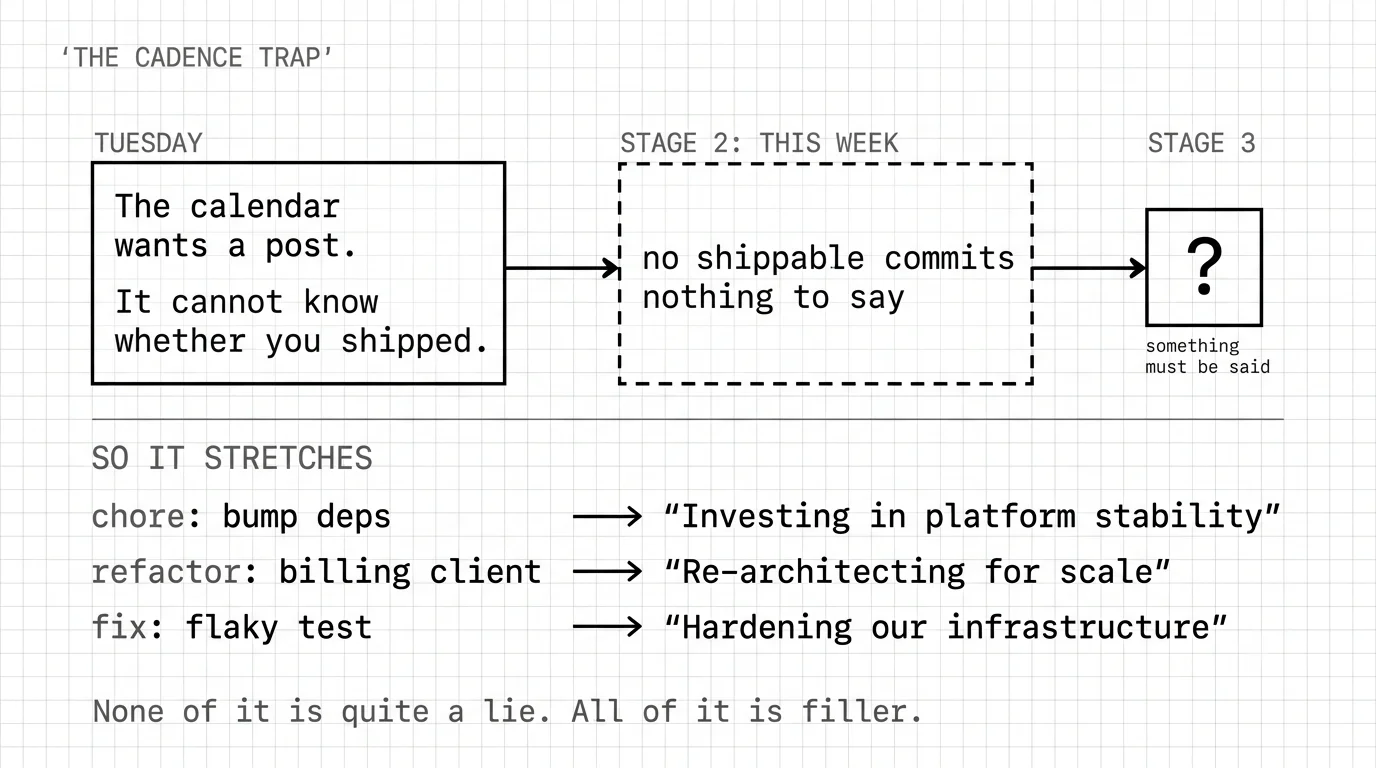
You set a cadence. You keep a content calendar. You decide you will post every Tuesday and Friday. And that decision, which felt like professionalism, quietly changes what you are doing: now the schedule needs feeding, and your shipping does not run on a schedule.
Some weeks you ship three things people care about. Some weeks you spend four days on a migration nobody will ever notice, and that is a good week. But the calendar does not know the difference. The calendar wants a post on Tuesday.
So on the Tuesday after the migration week, you have three options:
- Skip it, and feel the streak break.
- Post the migration, dressed up to sound like it matters to someone other than you.
- Post something generic. A lesson. A hot take. A thread about focus.
Option 2 and option 3 are how good build-in-public accounts turn into noise. Not through any single bad post, but through the slow accumulation of posts that exist because a slot existed. And your audience clocks it long before you do. They cannot tell you which post was filler, but they can tell that following you stopped being worth it.
The fix is to invert the dependency
Here is the whole idea, and it is not complicated:
Do not let the calendar decide when you post. Let the work decide.
A cadence-driven feed asks "it is Tuesday, what can I say?" A work-driven feed asks "I shipped something, is it worth saying?" These produce completely different outputs, and only one of them stays honest over a year.
| Cadence-driven | Work-driven | |
|---|---|---|
| Trigger | The calendar | A commit |
| Quiet week | Post filler | Post nothing |
| Failure mode | Invents things | Goes quiet |
| What readers learn | You post a lot | You ship |
The work-driven column has an obvious cost: you will post less. Some months, much less. Every piece of growth advice you have ever read says this is a mistake, that the algorithm punishes irregularity, that consistency compounds.
That advice is optimizing for reach. You should be optimizing for belief. A feed where every post is a real thing you really shipped is worth more than a feed with triple the volume and a 30% filler rate, because the filler does not merely fail to help. It actively withdraws from the trust that the real posts deposited.
What "going quiet" buys you
There is a version of this that most people never consider: silence is a signal.
If you only post when you ship, then a post from you means something shipped. Your feed becomes a reliable instrument. People start reading it as one, and a quiet month reads as "he was heads-down", not as "he gave up", because your feed has never once cried wolf.
Compare that to the feed that posts twice a week no matter what. A post from that account means it is Tuesday. There is no information in it. The signal-to-noise ratio has collapsed, and the person maintaining it is spending real hours a week to make it worse.
The tool that gets this right has to be willing to produce nothing. That is a strange thing to build. Every content tool on the market is sold on volume, and a tool whose pitch includes "sometimes it will write nothing at all" sounds like a defect. It is the opposite. Anything that must fill a slot will eventually fill it with something you did not do.
Practically, for a solo founder
You do not need a content strategy. You need a rule and a trigger.
The rule: every claim in a post traces back to something you shipped. If you cannot point at the commit, the sentence does not go in.
The trigger: you shipped something a user would notice. Not a refactor, not a dep bump, not a "hard week". Something that changed what a person can do.
That is it. No calendar. No pillars. No content buckets. When the trigger fires, write three sentences that obey the rule. When it does not fire, do nothing and feel nothing about it.
This is the whole thesis behind what we built. PeerPost reads the commits you already push and drafts the post for you, and on a stretch where you shipped nothing worth mentioning, it stays quiet rather than inventing something to say. You keep building. The marketing comes out of the building, instead of competing with it.
You do not have to become a marketer. You have to stop treating your shipped work as though it were not already the material.
Questions.
Does building in public actually work?
It works when the posts are grounded in real work, because specificity is what makes a stranger trust you. It stops working the moment you start posting to keep a schedule alive, because filler is obvious and it teaches people to scroll past you.
How often should I post if I am building in public?
As often as you ship something worth mentioning, and no more. A cadence borrowed from a content calendar will eventually demand a post on a week you have nothing to say, and that is the week you start making things up.
What if I am not comfortable promoting myself?
Then do not promote yourself. Report what you shipped. 'You can now export to CSV' is not self-promotion, it is a fact about a product, and it is more persuasive than any amount of enthusiasm.
Ask for an invite.
The platform turns the commits you already push into posts, and stays quiet when you have not shipped. Private beta, by invitation.