LinkedIn post generators for developers: what they get wrong
PeerPost5 min read

The category is now enormous. Paste a topic, pick a tone, get a LinkedIn post. Some of them are genuinely good at the job they were built for, which is producing publishable text quickly for people whose work is producing publishable text.
Then a developer tries one, reads the output, and closes the tab.
It is worth being precise about why, because "it sounds like AI" is the wrong diagnosis and leads people to the wrong fix.
The input is a topic, and a topic is not information
A generator asks you what the post is about. You type something like "shipped a new export feature". The model now has roughly nine words of information and a mandate to produce two hundred.
Everything it adds to close that gap is invented. Not maliciously - it is doing exactly what you asked - but the ratio is the whole problem. The post that comes back is mostly connective tissue: a hook, a moment of manufactured tension, three bullets of generic benefit, a closing question to farm comments.
None of that came from your work, because none of it could. You did not give it your work. You gave it a label for your work.
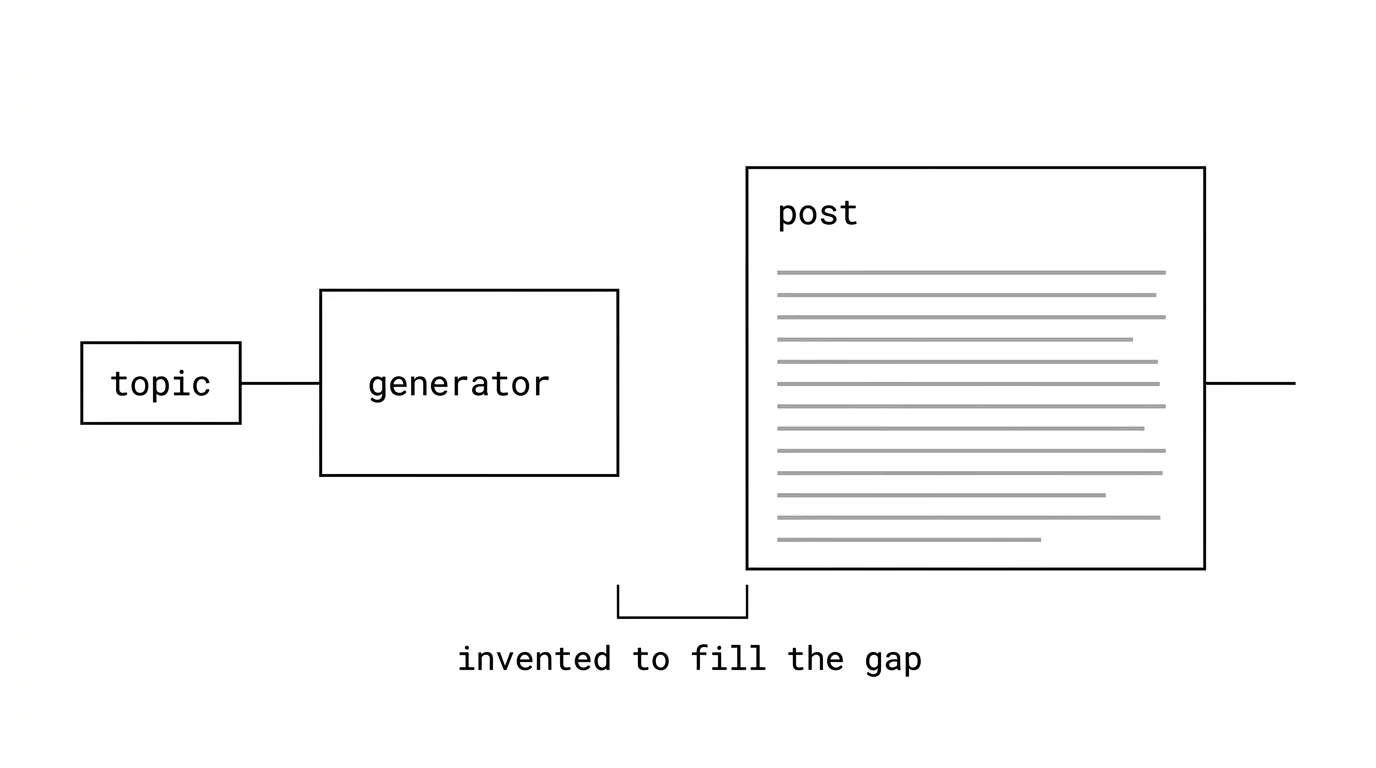
This is why "make it sound less like AI" never fixes anything. You can change the prose style and the post stays empty, because the emptiness was in the input.
The tells are structural, not stylistic
Ask people how they spot generated posts and they will describe surface features: the one-line paragraphs, the emoji bullets, the rhetorical question at the end. Those are real, and they are also the easiest thing in the world to prompt away.
The durable tells are different, and a developer audience reads them instantly:
Unfalsifiable claims. "We are investing in performance." Compared to what? Measured how? A claim nobody could check is a claim nobody has to believe.
Consequence without mechanism. "This will save teams hours every week." Which teams, doing what, that they cannot do now?
The tense giveaway. Generated posts drift toward the continuous and the aspirational: we are building, we are excited to be improving. Real ship reports are blunt and past tense: this now works, that used to break.
Your audience is people who read stack traces for a living. They are extremely good at noticing when a sentence contains no information.
What actually persuades a technical reader
One specific fact, stated plainly.
"You can now export any dashboard to CSV" is not a marketing sentence. It has no hook, no story arc, and no call to action. It also does more work than four paragraphs of enthusiasm, because it is checkable, it is new, and it tells a reader with that exact problem that their problem is solved.
Specificity is not a style. It is a consequence of having real input. Which means the interesting question about any of these tools is not how well it writes. It is what you can feed it.
The three questions worth asking of any of them
If you are evaluating tools in this category, the write-quality demo is the least informative part. Ask instead:
What does it read? A topic box means you supply the substance, forever, which is the work you were trying to avoid. A tool that reads your commits, your changelog, or your own notes about what shipped starts from evidence.
What does it do on a week you shipped nothing? This is the sharpest question in the category, because the honest answer is unattractive. A tool committed to a schedule has to produce something on a slow week, and the only material available is invention. A tool that will produce nothing has told you what it values. We wrote about that trade in full in why PeerPost stays quiet.
Can it publish without you? Auto-publishing is sold as convenience and priced in credibility. A tool with your posting rights, a queue to fill, and no human in the loop is one bad week away from announcing a feature you never built. If the answer is "you can turn autopilot on", note that the safeguard is a checkbox, and checkboxes get turned on.
And a fourth, for anything that touches your repository: what access does it ask for, and what could it read if it were breached? That one deserves its own page, and it has one: webhook or access token.
Where PeerPost sits
Plainly, since this is our blog and pretending otherwise would be silly.
PeerPost is not a topic box. It reads what you shipped - commits from the repositories you connect, or ship notes you write for the work that never touched a codebase - and drafts a post grounded in that. Every claim traces back to something that actually changed.
On a week with nothing user-visible in it, it writes nothing, and says so. And it has no auto-publish mode to turn on: the draft waits for you, always, because the alternative is a machine speaking in your name about work you did not do.
That is a narrower product than a generator. It also cannot produce the failure mode that made you close the tab.
If you build something and would rather not describe it for a living, request an invite.
Questions.
What is the best LinkedIn post generator for developers?
The useful question is not which generator writes the smoothest paragraph, it is which one takes your actual work as input. A generator fed a topic can only produce a genre exercise. A tool fed your commits or your ship notes can produce a specific claim, and specificity is the only thing that makes a stranger believe you.
Can AI write LinkedIn posts that do not sound like AI?
Yes, but not by being told to sound human. The tell is not the prose style, it is the absence of facts only you could know. Give a model a real change with a real consequence and the output stops sounding generic, because generic is what you get when there is nothing specific to say.
Is it safe to let a tool post to LinkedIn for me?
Only if you see every post before it goes out. A tool with publishing rights and a schedule to fill will eventually publish something you would not have written, in your name, on a week you were not paying attention. Approval before publishing is the safeguard, and it should be structural rather than a setting you can accidentally turn off.
Ask for an invite.
The platform turns the commits you already push into posts, and stays quiet when you have not shipped. Private beta, by invitation.