What to post on the weeks you shipped nothing
PeerPost5 min read

You did not ship this week. You spent it on a refactor nobody will ever see, two days chasing an integration bug that turned out to be a caching header, and a stretch of Thursday reading documentation.
Now it is Friday, and the advice you have absorbed from a hundred build-in-public threads is telling you to post something anyway. Consistency. Momentum. The algorithm.
Here is the honest answer, and then the four exceptions that are actually worth writing.
The default is nothing
Silence is not a failure to post. It is a position, and on most quiet weeks it is the correct one.
The reason is that filler is not neutral. It has a cost, and the cost is paid on the good weeks. Every post that contains nothing teaches your readers that a post from you might contain nothing. After enough of those, the post announcing the thing you spent two months building arrives at an audience that has already learned to scroll past your name.
An account that only speaks when it has something has the opposite property. A post from it is evidence. That is the whole asset, and filler is how you spend it.
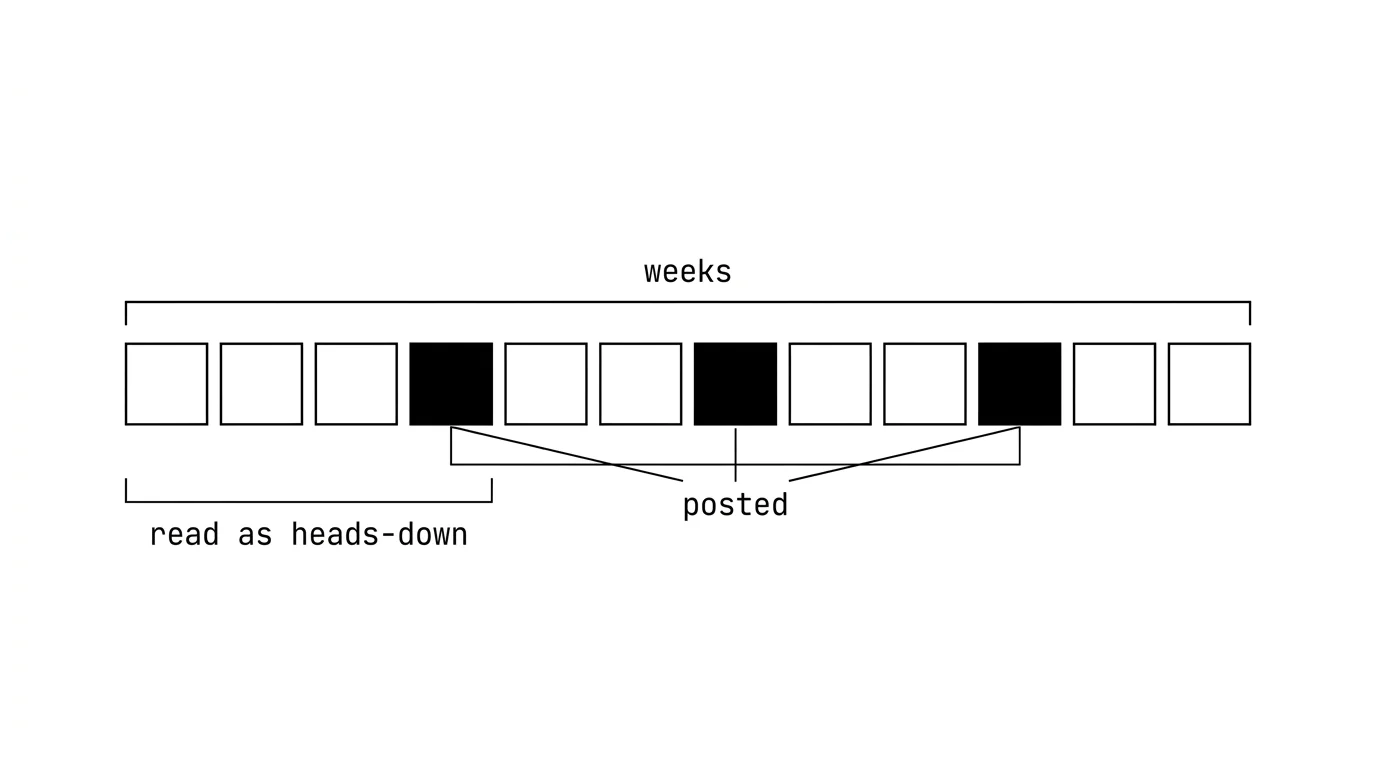
There is also a second-order effect that people underestimate: an account with no history of filler makes its silences legible. Three quiet weeks from someone who has never posted to fill a gap reads as heads-down. Three quiet weeks from an account that normally posts twice a week regardless reads as something has gone wrong.
We made the longer version of this argument, from the product side, in why PeerPost stays quiet.
The test
Before the exceptions, the filter that decides all of them:
Does this post contain a fact that only I could have supplied?
Not an opinion only you hold - opinions are cheap and a model can generate a hundred. A fact. A number from your own product, a decision you made and the reason, something a user told you, something that broke.
If someone with no knowledge of your product could have written the same post by prompting a model with your industry name, it is filler. It does not matter how well it reads.
Four posts that pass the test on a quiet week
The decision, and what it cost. You spent the week deciding not to build something. That is real work with a real outcome, and it is more interesting than most feature announcements, because everyone writes about what they built and almost nobody writes about what they declined. Name the thing, name the reason, name what you gave up. "We are not building a mobile app this year, because the three customers who asked for one all described a problem that is actually a notifications problem."
The thing that failed. The integration that took two days and turned out to be a caching header is a post. Not as a confession, and not dressed up as a growth lesson - just the specific shape of the problem and what the actual cause was. Other people will hit it. This is the single most useful genre a technical founder can write and the most consistently underused, because it feels like admitting you were slow.
The answer to a real question. A user asked you something this week and you wrote them a good reply. That reply is a post, near-verbatim. It is grounded by construction: a real person had the problem, and you answered it. The only edit needed is removing anything identifying.
A number you actually have. Not a vanity metric and not a milestone. Something you measured because you needed to know: how long onboarding takes, what fraction of signups connect anything, what the p95 was before and after the refactor. Your own numbers are unfakeable and nobody else can post them.
Notice that none of these require you to have shipped. They require you to have learned something specific, which is a different and much more common condition.
What does not pass
For completeness, because these are the ones that feel productive:
- The industry-trend take, where the only input was that a trend exists.
- "Building in public means showing the hard days too", with no hard day attached.
- The tool listicle assembled from tools you have not used in anger.
- The screenshot of a refactor. Your users do not experience your file structure.
- Anything that begins by announcing that you are going to be posting more.
Each of these can be written without knowing anything about your product, which is precisely the test failing.
The reframe that makes this easy
Stop thinking of posting as a rhythm you owe an audience and start thinking of it as a trigger. Something happens, and it produces a post. Nothing happens, and nothing is produced.
That reframe is what removes the guilt from a quiet Friday, and it is also what makes posting sustainable for someone whose actual job is building. You are not maintaining a channel. You are reporting facts as they occur.
It is also, not coincidentally, how we built PeerPost: it reads what you shipped and writes about that. On a week with nothing user-visible in it, it produces nothing at all rather than inventing something to fill the slot, and it never publishes anything without you seeing it first.
If you would rather report what you built than manage a content calendar, request an invite.
Questions.
What should I post when I have nothing to share?
Most weeks, nothing. Silence from an account that has never posted filler reads as heads-down, not as abandonment. The exceptions are posts that carry a fact only you have: a decision you made and why, something that failed, an answer to a real question, or a number from your own product.
Will my audience forget me if I stop posting for a few weeks?
Less than you fear, and far less than they will disengage if you post filler to stay visible. Attention is not a streak counter. People remember the accounts that were worth reading, and an account that only speaks when it has something is easier to remember, not harder.
How do I know if a post is filler?
Ask whether it contains a fact that only you could have supplied. If someone with no knowledge of your product could have written the same post by prompting a model with your industry name, it is filler, however well written it is.
Ask for an invite.
The platform turns the commits you already push into posts, and stays quiet when you have not shipped. Private beta, by invitation.