Marketing for solo developers who hate marketing
PeerPost6 min read

You built the thing. It works. You use it every day and it solves a real problem, and if a hundred of the right people tried it, some of them would pay.
Zero of them know it exists.
This is the part every guide skips past on its way to talking about funnels, and it is the only part that matters. You do not have a marketing problem. You have a nobody knows this exists problem, and most marketing advice is aimed at people who solved that a long time ago.
The advice does not fit you
Open any article about marketing your product and you will be told to define your ICP, build a personal brand, establish content pillars, nurture a funnel, and post consistently to grow an audience that you can later convert.
Every word of that is written for someone whose job is marketing. You have a different job. Yours is to make the product not fall over.
And here is what actually happens when a technical founder takes that advice seriously: you spend a weekend setting up the machinery. A content calendar. A Notion doc with pillars. Maybe a newsletter. You post four times. Then you ship a feature that breaks something in production, you spend the next week on it, and the machinery goes quiet forever, leaving behind a half-built apparatus that now makes you feel guilty every time you see it.
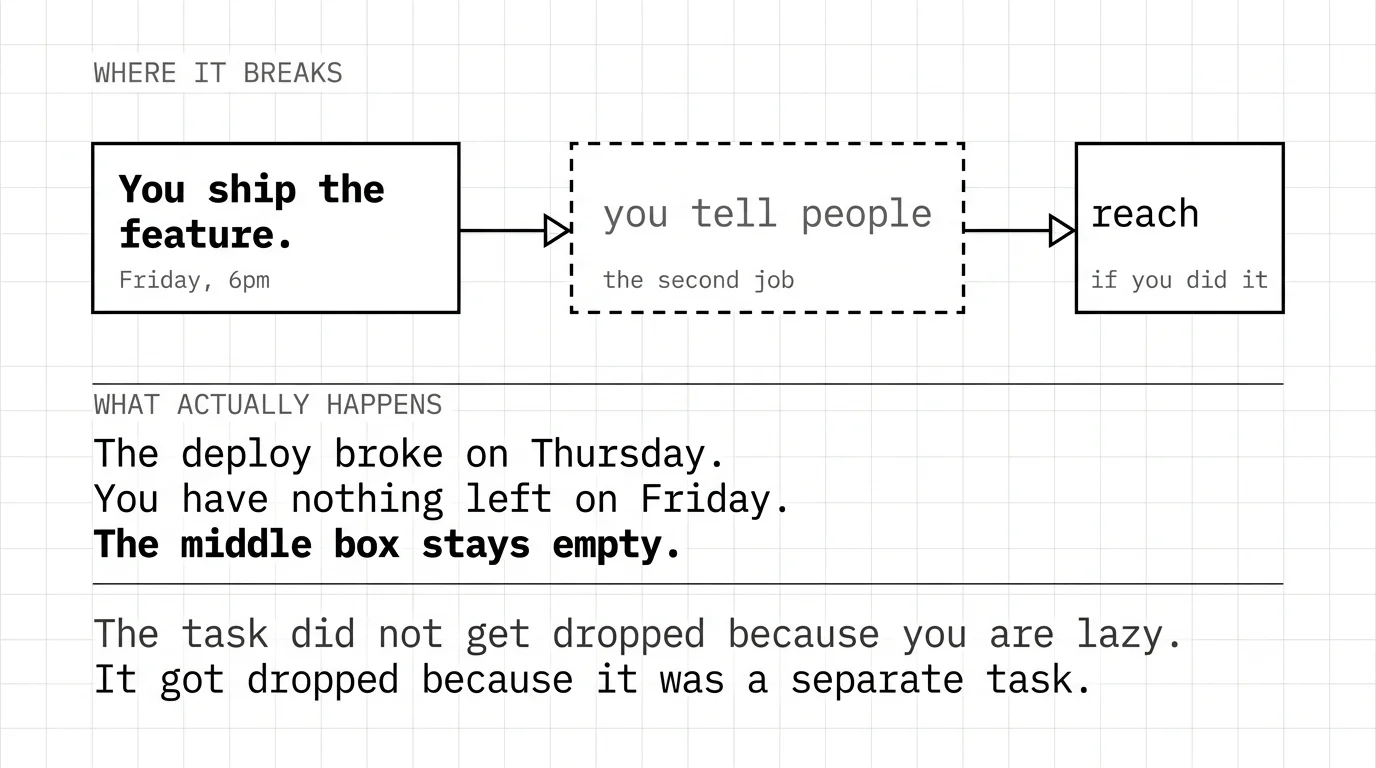
The machinery was never the problem. The problem is that it added a second job, and the second job always loses to the first one, because the first one is the one that breaks if you ignore it.
What you actually need
Strip it down. For a solo developer with a working product and no audience, marketing is two things:
- People find out it exists.
- They believe you when you say what it does.
That is the whole list. Everything else in a marketing playbook is an elaboration on one of those two, and most of it is an elaboration you do not need yet.
The good news is that the second one is nearly free for you and expensive for everyone else. You built the thing. You can describe exactly what it does, in specific terms, without exaggerating, because you do not need to exaggerate: you know precisely which problem it solves and precisely where it falls short. That specificity is the most persuasive asset in marketing, and non-technical founders spend enormous sums trying to fake it.
The bad news is the first one. Nobody is coming to find you.
The specificity advantage
Watch the difference between how a marketer describes a product and how the person who built it describes it.
| Marketer | Person who built it |
|---|---|
| "Streamline your workflow" | "It stops you re-typing the same delivery note into a spreadsheet" |
| "Enterprise-grade reliability" | "It has not gone down since March, and when it did I wrote up why" |
| "AI-powered insights" | "It reads your commits and writes the post for you" |
| "Trusted by builders" | "Four people use it. Two of them pay." |
The right column is worse marketing by every conventional measure and it is dramatically more effective on the people you are trying to reach, because the people you are trying to reach are like you: they have been lied to by the left column their entire careers and they have developed an immune response to it.
Your unfair advantage is that you can write the right column and mean it. Use it. Stop trying to sound like the left column. Every hour you spend learning to sound like a marketer is an hour spent degrading the one thing you have that marketers do not.
Say what you shipped, to people who care, repeatedly
Here is the strategy, and it is going to sound too simple.
Say specifically what you shipped. Say it where people who have that problem are. Do it again next time you ship.
That is it. That is the whole thing. No funnel, no pillars, no brand.
It sounds too simple because it is simple, and it is simple in the way that going to the gym is simple. The difficulty was never in understanding it. The difficulty is that it has to happen every time you ship, forever, and it competes directly with shipping for the same finite resource: your attention at the end of a long week.
Which is why it decays. Not because you are lazy, and not because you failed to internalise a growth mindset. Because you built a system where telling people is a separate task from doing the thing, and separate tasks get dropped.
Make the telling fall out of the doing
The only version of this that survives a year is one where the marketing is a byproduct of the work rather than a second job stacked on top of it.
Concretely, that means the raw material for the post has to already exist by the time you sit down to write it. And it does. It is your commit history. You already wrote down what you shipped, at the moment you shipped it, in your own words. That is not a marketing asset yet, but it is one step away from being one, and it is the only record that is guaranteed to be complete and honest, because you wrote it for yourself with no audience in mind.
We wrote up the manual version of that translation in how to turn GitHub commits into LinkedIn posts. It takes about ten minutes a week and it works, and you should try it, because you will learn what your own shipped work actually sounds like from outside.
You will also learn why it does not last. Ten minutes at the end of a week where the deploy broke is not ten minutes. It is ten minutes of the wrong kind of thinking at the exact moment you have none of it left.
That is the gap PeerPost was built to close. It reads the commits you already push, drafts the post, and hands it to you. You keep shipping, which is the part you are good at and the part you would be doing anyway. And on the weeks you shipped nothing worth telling anyone about, it says nothing, because the alternative is making something up, and making things up is how you lose the one advantage you actually had.
You do not have to learn to like marketing. You have to stop letting it be a separate job.
Questions.
Do I need a personal brand to sell a product as a solo developer?
No. You need people to find out the product exists and to believe you when you describe it. A personal brand is one way to get there and it is not the only one, and for most technical founders it is the most expensive one.
How much time should a solo developer spend on marketing?
Less than you fear and more than zero. The goal is not to maximise hours spent marketing, it is to stop the shipping and the telling-people from being two separate jobs, because the second job is the one that gets dropped.
What is the highest-leverage marketing for a technical founder?
Saying specifically what you shipped, to people who care about that problem, repeatedly. It sounds too simple to be a strategy, which is exactly why so few people do it.
Ask for an invite.
The platform turns the commits you already push into posts, and stays quiet when you have not shipped. Private beta, by invitation.